
AI-Powered Farming: Carbon Robotics Builds Smart Model That Can Recognize Plants Instantly

New technology could transform how farmers remove weeds
Artificial intelligence is slowly entering every industry — and now agriculture is getting a major upgrade.
US-based company Carbon Robotics has introduced a powerful new AI system that can instantly detect and identify plants in real time. The breakthrough could significantly change how farmers manage weeds, reduce chemical usage, and improve crop productivity.
Instead of relying on manual labeling or retraining machines again and again, this new model allows farm robots to understand plant types almost instantly.
What exactly did Carbon Robotics build?
The company developed what it calls a Large Plant Model, an AI system trained on a massive global database of plant images. Think of it like ChatGPT — but for plants.
Earlier farming robots needed to be retrained every time they encountered a new weed. That process could take hours or even a full day. With this new AI model, farmers can simply show the robot what plant to target, and it understands immediately.
This eliminates downtime and makes automated farming tools far more practical in real-world conditions.
According to Carbon Robotics’ leadership, the goal was to create a model that learns plant behavior broadly, instead of memorizing specific cases.
How the Laser Weeding Robot works
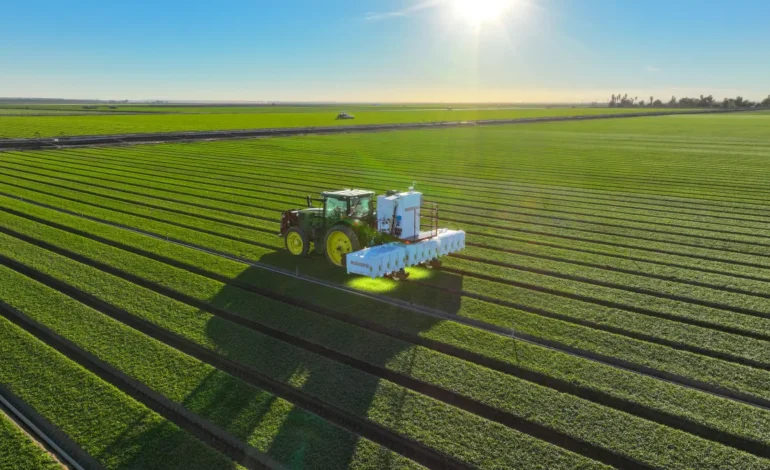
Carbon Robotics is best known for its LaserWeeder, a robot that removes weeds without chemicals. The machine uses cameras and AI vision to scan farmland, identify unwanted plants, and destroy them using precision laser pulses.
Yes — it literally zaps weeds with lasers.
The new AI upgrade makes the LaserWeeder smarter and faster. It can now adapt to different crops, climates, and field conditions without constant software retraining.
For farmers, this means:
- Less manual intervention
- Faster decision-making
- Reduced chemical herbicide use
- Healthier soil and crops
And all of this happens automatically while the robot moves through the field.
Why this matters for the future of agriculture
Modern farming faces big challenges: labour shortages, rising costs, and environmental concerns. AI-driven machines like Carbon Robotics’ system could help farmers grow more food with fewer resources.
The Large Plant Model is also trained on plant data from multiple continents, making it flexible enough to work across different regions. This could be especially useful in countries with diverse crops and climates.
Beyond weed control, experts believe similar AI models could eventually monitor plant health, predict disease outbreaks, and optimize yields.
In short, agriculture is becoming smarter — and robotics is playing a major role.
A glimpse into AI-powered farming
Carbon Robotics’ innovation shows how artificial intelligence is moving beyond software and into the physical world. Instead of just generating text or images, AI is now helping solve real-world industrial problems.
For farmers, the technology promises higher efficiency and sustainability. For the tech industry, it’s another sign that AI is expanding into unexpected sectors.
As precision agriculture continues to grow, tools like this may soon become standard equipment on farms worldwide.
For more updates.
Image credit: TechCrunch, Carbon Robotics