Supreme Court Rules BCI Has No Power to Discipline Law Students Before Enrolment

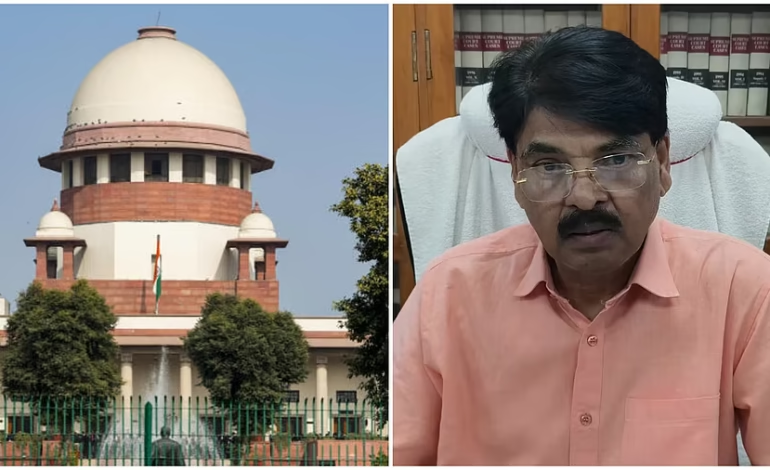
The Supreme Court on Thursday, September 3, 2026, settled an important issue concerning the powers of the Bar Council of India (BCI). It held that the BCI and the State Bar Councils have no statutory powers to initiate disciplinary action against law students before they are enrolled as advocates.
The decision was taken by a three-judge bench comprising Chief Justice of India Surya Kant, Justice Joymalya Bagchi and Justice V. Mohana while hearing the controversy involving students of the National Academy of Legal Studies and Research (NALSAR), Hyderabad. This case is Mihira Sood & Anr. Vs. Bar Council Of India & Ors. – W.P.(C) No. 1040/2026. The Supreme Court had fixed September 3 for hearing the case.
The Supreme Court stated that
The main issue before the Supreme Court was whether the Advocates Act, 1961 empowers the BCI or State Bar Councils to take punitive action against a person who is still a student of law and has not yet enrolled as an advocate.
The Court answered in the negative.
The bench in its order said the Advocates Act does not provide any express or implied power to the BCI or a State Bar Council to take disciplinary action against law students. That disciplinary power comes into operation, after a law graduate is enrolled as an advocate under the Act.
In the case of students, the Court held that the disciplinary authority was the parent institution or the authority specified in its regulations or bye-laws.
That’s a pretty big difference. The BCI has the power to prescribe and enforce standards in relation to legal education within the statutory framework. But regulation is not the same as direct disciplinary control of every law student
“Thus, the Court held that the BCI communications dated August 13, 2026 and the subsequent modified communications were issued without any legal authority. Earlier, the students of NALSAR were given absolute interim protection.
The Birth of the NALSAR-BCI Conflict
This follows a controversy at NALSAR University of Law in Hyderabad over the proposed participation of CJI Surya Kant as chief guest at the university’s convocation.
Students have launched a campaign opposing the CJI’s proposed participation. Later, BCI Chairman and Senior Advocate Manan Kumar Mishra intervened in the matter.
On August 13, the BCI issued communications directing that students from NALSAR’s 2026 graduating batch should not be enrolled as advocates until further orders. The communications also sought information concerning students and others connected with the campaign and called for an inquiry into the episode.
The BCI subsequently withdrew the communications. The withdrawal, however, did not end the legal question before the Supreme Court.
Two NALSAR alumni, Mihira Sood and Abhishek Tiwari, approached the Supreme Court challenging the BCI’s intervention. Their case raised a broader question: could the professional regulator of advocates exercise disciplinary authority over people who were still students and had not entered the legal profession?
The Supreme Court had earlier directed that no punitive action be taken against NALSAR students or faculty members at the instance of the BCI or any State Bar Council in relation to the controversy.
BCI’s authority over law students: what the judgment means
The ruling does not remove the BCI from legal education.
The Bar Council of India continues to have statutory responsibilities concerning standards of legal education and the regulation of the legal profession. The Supreme Court’s ruling instead draws a line between regulating legal education and disciplining individual students.
That distinction matters because a person studying for a law degree is not automatically an advocate merely because they intend to practise law after graduation.
The Court’s reasoning places disciplinary control over student conduct primarily within the university’s institutional framework. If a student violates university rules, the institution or the authority designated by its regulations can take appropriate action.
The BCI, however, cannot simply assume disciplinary jurisdiction over that student before enrolment as an advocate.
What happens when a student becomes an advocate?
The legal position changes after enrolment.
Once a law graduate is enrolled as an advocate, the person enters the statutory framework governing the legal profession. At that stage, the Bar Council has regulatory and disciplinary responsibilities over professional conduct.
The Supreme Court specifically distinguished this position from that of a law student. As reported from the proceedings, the Court made clear that the BCI’s disciplinary role comes into the picture after a law graduate registers as an advocate, rather than while the person remains a student.
This means the ruling should not be understood as saying that the BCI has no authority over anyone connected with legal education. Its powers concerning legal education and its statutory role over enrolled advocates remain distinct questions.
What it means for law students
For Indian law students, the ruling establishes an important jurisdictional boundary.
A student facing disciplinary proceedings for conduct during legal education would ordinarily have to answer to the university or institution under its applicable rules. A professional regulator cannot substitute itself for that institutional disciplinary mechanism merely because the student is studying law.
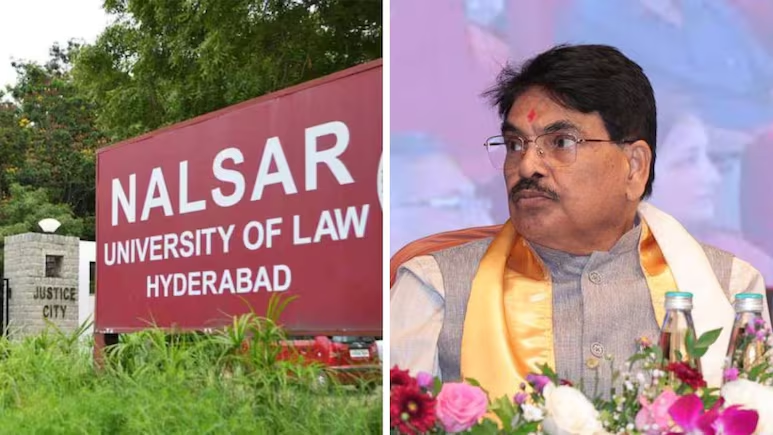
Image credits: NDTV
The judgment is also significant because the dispute involved a student campaign and questions surrounding institutional and student conduct. The Court’s ruling means that the BCI cannot use its statutory authority over the legal profession as a general mechanism for controlling student conduct before enrolment.
That does not mean law students are exempt from disciplinary rules. Universities retain the power to enforce their own regulations, and students remain subject to applicable institutional rules and other laws.
The ruling instead answers who has statutory disciplinary jurisdiction over them in their capacity as students.
Supreme Court’s ruling versus comments during the proceedings
It is important to distinguish the Court’s final legal ruling from comments made during the earlier proceedings.
During the August proceedings, CJI Surya Kant had strongly criticised the BCI’s intervention and questioned its role in the NALSAR dispute. Reports from that hearing also recorded his comments concerning the students’ right to protest.
Those remarks should not be confused with the formal legal determination delivered on September 3.
The operative ruling is the Court’s declaration that the Advocates Act does not confer express or implied disciplinary power over law students on the BCI or State Bar Councils, and that the August 13 communications and subsequent modified communications were issued without authority of law.
Key takeaways
- BCI cannot discipline law students: The Supreme Court held that the BCI and State Bar Councils have no statutory disciplinary power over students before they are enrolled as advocates.
- Universities have disciplinary authority: Student conduct falls within the jurisdiction of the educational institution or an authority empowered under its rules and regulations.
- BCI still regulates legal education: The judgment does not eliminate the BCI’s statutory role in prescribing and enforcing standards of legal education.
- Enrolment marks an important legal distinction: The BCI’s disciplinary authority over professional conduct applies within the statutory framework governing enrolled advocates.
- NALSAR communications were declared without authority: The Court held that the BCI’s August 13 communication and subsequent modified communications were issued without jurisdiction.
- The case arose from the NALSAR convocation controversy: The dispute followed a student campaign concerning the proposed participation of CJI Surya Kant at NALSAR’s convocation.
Case details
Case: Mihira Sood and Another v. Bar Council of India and Others
Case Number: W.P.(C) No. 1040/2026
Court: Supreme Court of India
Bench: Chief Justice Surya Kant, Justice Joymalya Bagchi and Justice V. Mohana
Decision Date: September 3, 2026
Conclusion
The Supreme Court’s NALSAR ruling provides a clear answer to the question of BCI disciplinary power over law students. The BCI’s authority as the statutory regulator of the legal profession does not extend to disciplining students before they become enrolled advocates.
For students, disciplinary questions during legal education remain primarily within the framework of their university or educational institution. For the BCI, the ruling reinforces the importance of exercising statutory powers within the limits set by the Advocates Act.
The immediate NALSAR controversy may have begun with a particular dispute, but the Supreme Court’s ruling establishes a broader legal distinction between being a law student and being an enrolled advocate. That distinction is now central to understanding the limits of the Bar Council’s disciplinary authority.
Feature Image Credits: deccanherald
For more: News