AI in the Workplace: How Artificial Intelligence Is Changing Jobs and Skills

Artificial intelligence has left the realm of science fiction and is now part of our daily working life. Now, companies use AI to compose emails, analyze data, prepare presentations, respond to customer questions and automate mundane tasks. As adoption grows, the workplace is changing – not just with automation but with employes learning to work with AI.
The question is no longer whether AI will change work. It is already. The bigger question is how can employes and businesses adjust to the changing workplace.
AI Is Becoming Part of Everyday Work
A few years ago, AI at work was often about experimenting with new tools. Today, AI is being embedded in many business processes in a practical way.
Marketers are using AI to learn about their audiences and come up with ideas. It’s used by developers to help with coding. Analysts can work thru large amounts of information more quickly, and project managers can use AI to sort out tasks, summarize meetings and highlight possible risks.
The aim is not necessarily to replace people. In many cases, artificial intelligence can free up employes’ time to focus on work that requires human judgment.
For example, an employe may spend an hour reading a long report to pick out the important information. An AI tool can summarize the report in minutes.” But what all that information actually means to a business still needs human judgment.
AI is able to process information. People give context.
AI Is Changing the Skills Employers Value
As AI handles more repetitive tasks, the skills employers value are also changing.
Technical knowledge remains important, but employees increasingly need to understand how to work effectively with AI tools. This includes knowing when to use AI, how to evaluate its output and when human judgment is necessary.
Important workplace skills include:
- Critical thinking
- Problem-solving
- Communication
- Data interpretation
- Creativity
- Adaptability
- AI literacy
- Decision-making
Employees do not necessarily need to become programmers or AI engineers.
For example, a project manager may not need to build an AI model. However, understanding how AI can support planning, reporting, documentation and risk management can make that professional more effective.
The same principle applies across many industries.
AI Will Not Replace Every Job, But Jobs Will Change
Job displacement remains one of the biggest concerns surrounding artificial intelligence.
When technology can complete tasks that previously required hours of human effort, employees naturally question how their roles might change.
Technology has transformed the workplace before. Computers changed office work, the internet reshaped communication, and smartphones changed how businesses interact with customers.
AI represents another major shift.
Instead of asking only whether AI will replace a particular job, businesses and employees can ask a more practical question:
Which parts of this job can AI handle, and which parts still require a human?
A job may not disappear, but its responsibilities and daily workflow could change significantly.
Human Judgment Still Matters
AI can analyze information and generate possible solutions, but human judgment remains important in situations involving emotions, trust, responsibility and incomplete information.
Understanding customers, handling sensitive situations and making difficult decisions require more than processing data.
For example, an AI system may suggest several solutions to a business problem. A person still needs to determine which option is appropriate for the customer, employees and organization.
Human judgment also involves understanding company culture, relationships and consequences. These factors can be difficult to capture through automated systems alone.
AI Skills Can Improve Workplace Productivity
Learning to use AI effectively can help employees complete certain tasks more efficiently.
Depending on their profession, workers may use AI for:
- Research assistance
- Document summaries
- Data analysis
- Meeting notes
- Content ideas
- Customer support
- Task organization
- Software development
- Report preparation
However, productivity gains depend on how these tools are used. Employees still need to check AI-generated information, protect confidential data and understand the limitations of automated systems.
The Future Workplace Will Combine People and AI
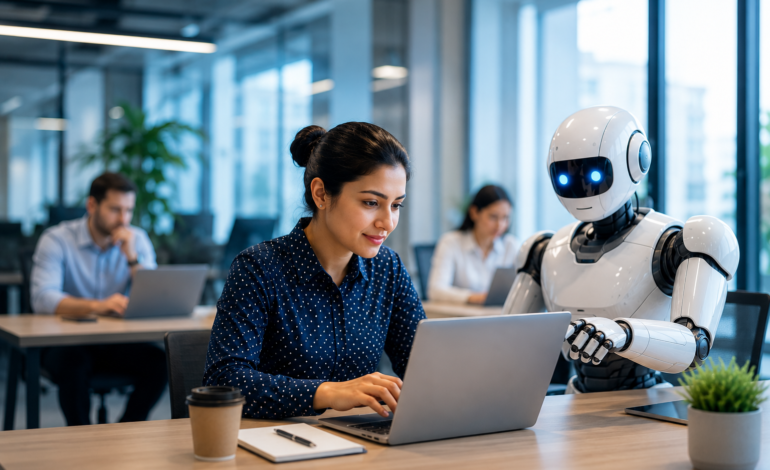
The future of work is unlikely to be simply about humans competing against AI. Instead, businesses are increasingly likely to combine human expertise with AI-assisted workflows.
An employee who understands their profession and knows how to use AI responsibly may be able to complete certain tasks more efficiently than someone relying entirely on traditional methods.
At the same time, companies will need to provide training and establish clear guidelines for responsible AI use.
How Employees Can Prepare for AI at Work
Employees can begin preparing for the changing workplace by developing both professional and AI-related skills.
Practical steps include:
- Learn the AI tools relevant to your profession.
- Understand how to write clear prompts and instructions.
- Verify AI-generated information before using it.
- Continue developing communication and critical-thinking skills.
- Learn how AI can improve existing workflows.
- Understand data privacy and responsible AI use.
- Focus on tasks that require creativity, judgment and human interaction.
The objective is not to become dependent on AI. Instead, employees should learn how to use it as a productivity tool while retaining responsibility for their work.
Businesses Must Prepare for an AI-Driven Workplace
Employees are not the only ones who need to adapt. Businesses also need clear strategies for introducing AI into their operations. Companies can begin by identifying repetitive tasks, evaluating suitable AI tools and training employees to use them responsibly. Businesses should also establish policies covering data protection, accuracy, human review and acceptable AI use.
A thoughtful approach can help organizations gain productivity benefits without losing the human oversight required for important decisions.
The Future Belongs to People Who Adapt
AI is changing how work is performed across industries. However, the transition is not simply about replacing human workers with machines. Instead, many jobs are likely to evolve as AI takes responsibility for certain repetitive tasks while people focus more heavily on judgment, creativity, communication and problem-solving. The most valuable employees may not be those who compete with AI, but those who understand how to work effectively alongside it.
The future workplace will be shaped by both technology and people—and the ability to adapt will remain one of the most important skills of all.